

How Much Faster Are Private Jets Compared to Commercial Planes
When time is your most valuable asset, the question of travel efficiency becomes paramount: how fast can a private jet fly compared to commercial airlines? However, the answer extends far beyond simply comparing raw airspeed figures.
True travel efficiency is a holistic view that encompasses a range of factors: streamlined processes that minimise ground time, optimal routes that circumvent congested airspace, and minimal delays that ensure you arrive at your destination precisely when needed. It's about maximising every moment of your journey, not just the time spent in the air.
How Fast Do Private Jets Fly?
Private jets typically fly at speeds comparable to or slightly faster than commercial airlines, often ranging from Mach 0.7 to Mach 0.94. While modern commercial airliners can also go up to Mach 0.85, the key difference lies in how private jets are able to maintain these speeds more consistently and directly.
Fastest Private Jets
Bombardier Global 8000
The Bombardier Global 8000 stands as a pinnacle of speed and range in the private jet sector, designed for ultra-long-haul flights with unmatched performance.
- High-Speed Cruise: Mach 0.92
- Maximum Operating Mach Number (Mmo): 0.94
- Maximum Range: 14,816 km
- Feature: Smooth Flĕx Wing, which is engineered like two wings in one: a high-lift wing for exceptional low-speed agility and a high-speed wing for unrivalled speed and range.
Gulfstream G800
The Gulfstream G800 is a marvel of modern aviation, combining speed, range, and fuel efficiency for the most demanding travellers.
- High-Speed Cruise: Mach 0.9
- Maximum Operating Mach Number (Mmo): 0.925
- Maximum Range: 14,816 km
- Features: Next-generation Rolls-Royce Pearl 700 engines paired with Gulfstream’s advanced aerodynamic wing and avionics, delivering both speed and impressive fuel efficiency.
Dassault Falcon 10X
The Dassault Falcon 10X represents the future of ultra-long-range business travel, offering exceptional speed and comfort.
- High-Speed Cruise: Mach 0.9
- Maximum Operating Mach Number (Mmo): 0.925
- Maximum Range: 13,890 km
- Features: High-aspect-ratio wings crafted from high-performance composites, equipped with Smart Throttle and two Rolls-Royce Pearl® 10X engines, ensuring both power and efficiency.
Why Are Private Jets Faster Than Commercial Planes?
Reduced Payload
Private jets typically carry fewer passengers and cargo than commercial airlines, allowing them to achieve higher speeds and faster acceleration than commercial planes. This lighter payload translates to improved performance and reduced fuel consumption.
Lighter Mass
The smaller size and advanced materials used in private jet construction contribute to a lighter overall mass, enabling faster acceleration and higher cruising speeds. This reduced weight enhances the aircraft's agility and efficiency.
Flies at Higher Altitudes
Private jets often fly at higher altitudes than commercial airlines, where air density is lower, resulting in less drag and higher speeds. This allows them to achieve optimal performance and fuel efficiency.
Flight Routes and Air Traffic
Private jets enjoy greater flexibility in flight routing, allowing them to take more direct paths and avoid congested airspaces. This freedom from fixed routes and air traffic constraints leads to shorter flight durations and more efficient travel.
Beyond Airspeed: Time Savings on the Ground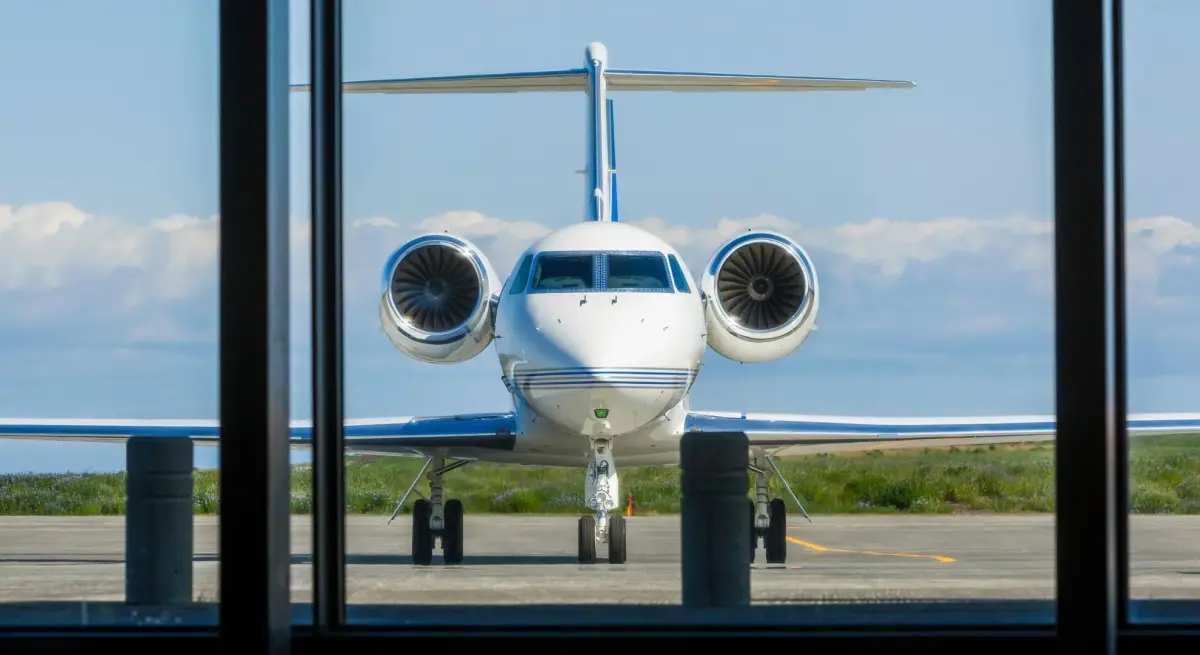
Beyond the sheer velocity achieved in the air, the benefits of flying private extend to time savings on the ground. The experience begins and ends with an efficiency that commercial travel simply cannot replicate.
Gone are the lengthy security lines that often consume hours of a traveller's time. Instead, passengers enjoy a faster, seamless transition from vehicle to aircraft, with minimal waiting. The frustration of baggage claim is also eliminated, as luggage is typically handled with personalised care and delivered promptly upon arrival.
Boarding itself becomes a matter of mere minutes, with passengers often able to arrive shortly before their scheduled departure. This expedited process is further enhanced by access to private terminals, known as Fixed Base Operators (FBOs), which provide a discreet and comfortable environment, devoid of the crowds and delays associated with major commercial airports. This combination of streamlined procedures transforms the entire travel experience, allowing for a level of efficiency that maximises productivity and minimises the stress associated with traditional air travel.
How Much Time Can I Save Flying Private?
To truly grasp the time efficiency of private jet travel, let's quantify the time investments:
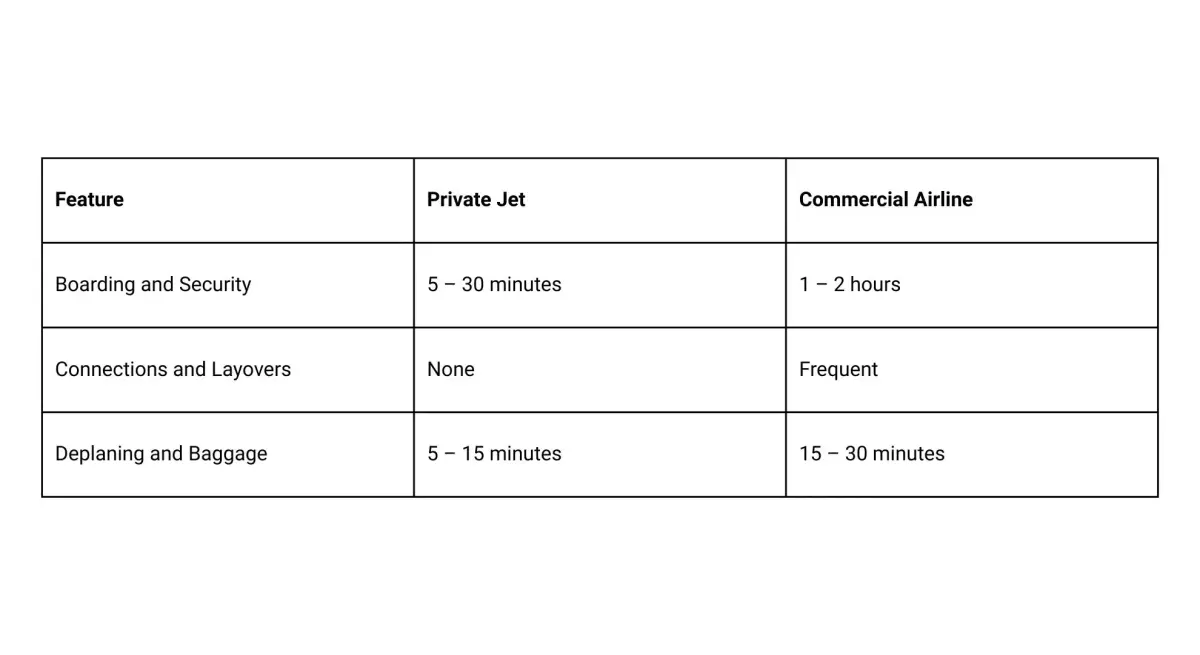
Consider the practical implications of these differences. For instance, a flight from Singapore to Kuala Lumpur, a route frequently traversed by business professionals, can be completed in approximately 30 minutes via private jet, significantly faster than the one hour and ten minutes required for a commercial flight.
Similarly, flying from John F. Kennedy International Airport in New York to Miami International Airport, can be accomplished in one to two and a half hours with a private jet. In contrast, commercial flights often extend to three and a half hours. These comparisons reveal how private air travel gives you back valuable hours, allowing you to reclaim time for what matters most.
Speed and Efficiency Redefined
While the raw airspeed of a private jet might not drastically outpace that of a commercial airliner, the true advantage lies in the comprehensive travel experience. When you choose private aviation, you're not just buying a flight; you're investing in a seamless journey. It's about reclaiming valuable time, minimising stress, and arriving at your destination refreshed and ready, whether for business or leisure.
For the discerning traveller, flying via private jet redefines the very essence of speed and efficiency, transforming travel from a necessary chore to a strategic advantage. Contact Jetbay to charter a private jet and discover how you can further optimise your travel time.
Frequently Asked Questions About How Fast Do Private Jets Fly
Which is the fastest private jet?
The Bombardier Global 8000 stands at the forefront of private jet speed, boasting a remarkable Mach 0.9 cruise speed and a Mmo of 0.94. This impressive performance is attributed to its meticulously engineered advanced aerodynamics and powerful, high-efficiency engines, enabling it to traverse vast distances with exceptional velocity.
Which is the fastest commercial plane?
The legendary Concorde, now retired, holds the distinction of being the fastest commercial aircraft ever built, regularly operating at twice the speed of sound at Mach 2.04. Modern commercial airliners, while not reaching supersonic levels, typically cruise at speeds ranging from Mach 0.79 to 0.85, representing a balance between speed and fuel efficiency.
Do private jets have a speed limit?
Private jets, like all aircraft, are subject to speed limitations. These limits are primarily defined by the Maximum Operating Mach number (Mmo), which is a critical safety parameter designed to ensure the structural integrity of the aircraft and prevent it from exceeding its design capabilities.
How does private jet altitude impact speed?
Altitude plays a significant role in determining private jet speed. As an aircraft ascends to higher altitudes, the air density decreases, resulting in reduced aerodynamic drag. This reduction in drag allows the aircraft to achieve greater speeds and improve fuel efficiency, contributing to faster overall travel times.
Are private jets affected by air traffic control delays?
While private jets enjoy greater flexibility in flight routing and scheduling compared to commercial airlines, they’re not entirely immune to air traffic delays. Factors such as congested airspaces, airport traffic, and air traffic control procedures can still impact their flight paths and arrival times, although typically to a lesser extent than commercial flights.
How do weather conditions impact private jet speed?
Weather conditions can significantly influence private jet speed and flight duration. Strong headwinds can reduce ground speed, while turbulence and storms may necessitate adjustments to flight paths or altitudes, potentially leading to increased travel times. Pilots are trained to assess and mitigate the effects of adverse weather, ensuring safe and efficient flight operations.