

How Far Can a Private Jet Fly without Refueling?
Soaring through the skies on a private jet offers unparalleled freedom and flexibility. But just how far can these magnificent machines take you without needing to refuel?
Some private jets are built for transcontinental journeys, capable of flying for thousands of miles without needing to refuel. Others are designed for shorter hops, perfect for regional travel or quick getaways. Knowing the capabilities of how far a private jet can fly allows you to tailor your travel plans to your exact needs and desires, especially if you're aiming for distant shores or a multi-leg adventure.
Whether you're seeking a non-stop flight from Singapore to London or a series of island hops in the Maldives, choosing the right private jet charter for your travel ambitions is paramount.
How Far Can a Private Jet Fly without Refuelling?
When answering the question of how far a private jet can fly without refuelling, there’s one key metric to look at: range. This refers to the maximum distance a private jet can travel on a single tank of fuel. Range is influenced by several factors, most notably the aircraft's fuel capacity and fuel efficiency. Larger jets with bigger fuel tanks can naturally fly farther, but technological advancements in engine design and aerodynamics also play a significant role in maximising fuel efficiency and extending range.
To illustrate the range of different private jets, let's look at a comparison table:
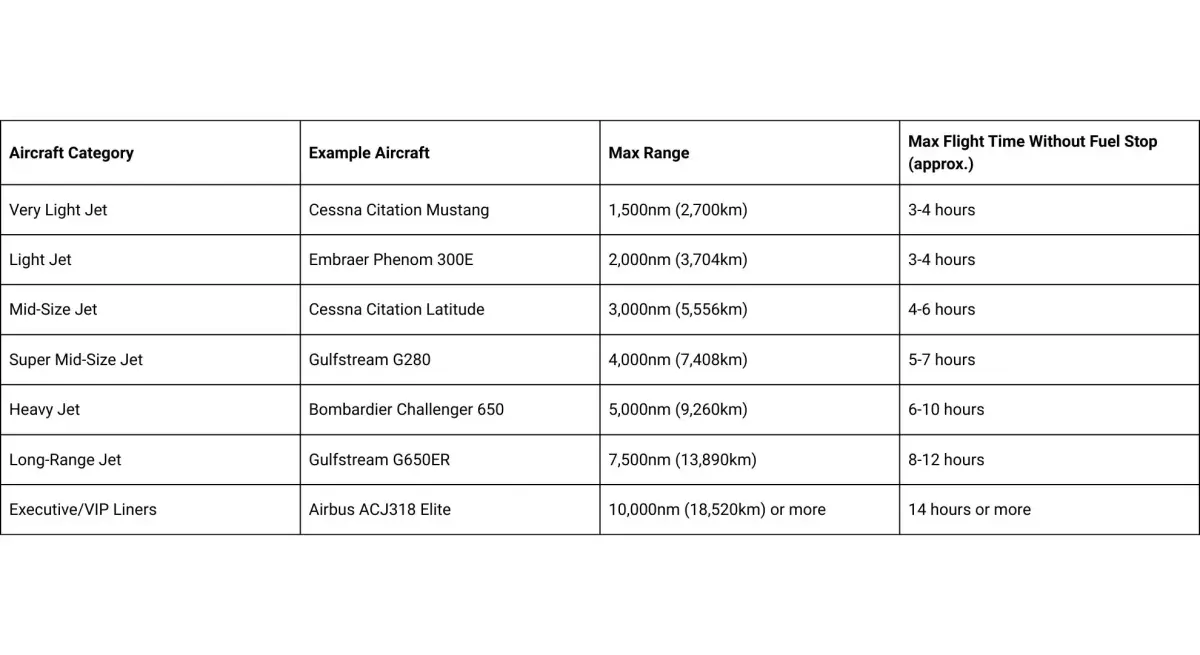
For reference, the distance between New York’s John F. Kennedy International Airport to London’s Heathrow Airport is roughly 2,999nm (5,555km). So mid-to long-range jets can comfortably complete transatlantic flights without needing to refuel. This opens up a world of possibilities for travellers seeking to reach distant destinations quickly and efficiently.
Factors Influencing Flight Duration
Several factors can affect how long a private jet can fly and its range. Understanding these factors can help you make informed decisions when planning your private jet journey.
Aircraft class
The class of the aircraft plays a significant role in determining how far a private jet can fly without refuelling. Larger, heavier jets like the Bombardier Global 7500 or Gulfstream G700 have greater fuel capacity, allowing them to fly longer distances. Conversely, smaller jets like the Cessna Citation CJ3+ or Embraer Phenom 100EV have shorter ranges due to their smaller fuel tanks.
Fuel Capacity
Jets with larger fuel tanks can naturally fly farther without refuelling. However, fuel capacity is often balanced against other factors like passenger capacity and baggage space. For larger jets, maximum range and flight time is typically calculated on the assumption of just two passengers aboard the aircraft.
Aircraft Design and Efficiency
Advancements in aerodynamics and engine technology have led to greater fuel efficiency, which in turn affects how long a private jet can fly. Features like winglets, advanced engine designs, and lightweight materials all contribute to reducing fuel consumption and extending range.
Flight Speed
Flight speed can also influence how far a private jet can fly without refuelling. While flying at higher speeds can reduce travel time, it also increases fuel consumption. Private jets often fly at optimal speeds to balance speed and fuel efficiency in order to maximise their range.
Weather Conditions
Strong headwinds or adverse weather conditions can increase fuel consumption and reduce range. Pilots need to carefully consider weather patterns when planning flight routes to optimise fuel efficiency, which may necessitate flying a longer, more indirect course to avoid inclement weather.
Weight and Balance
The total weight of the aircraft, including passengers, baggage, and fuel, affects its range. A heavier aircraft requires more fuel to take off and maintain altitude, reducing its overall range.
Types of Private Jets By Range
When considering how far you want to fly on a private jet, it's essential to select the right type of aircraft for your needs. Here's a breakdown of private jet categories based on their range:
Very Light Jets
Very Light Jets are the smallest category of private jets, offering cost-effective solutions for short-distance travel. They typically seat 4-6 passengers and have a range of up to 1,500 nautical miles (approximately 2,770 km). Examples include the Cessna Citation Mustang and the Embraer Phenom 100EV.
Light Jets
Light jets offer a balance of comfort, efficiency, and range, making them suitable for regional travel and short-haul international flights. They typically seat 5-10 passengers and have a range of up to 2,000 nautical miles (approximately 3,704 km). Examples include the Embraer Phenom 300E and the Cessna Citation CJ4.
Mid-Size Jets
Mid-size jets provide more space and amenities than light jets, making them suitable for longer flights and larger groups. They typically seat 8-12 passengers and have a range of up to 3,000 nautical miles (approximately 5,556 km). Examples include the Cessna Citation Latitude and the Hawker 800XP.
Super Mid-Size Jets
Super mid-size jets bridge the gap between mid-size and heavy jets, offering a combination of range, comfort, and efficiency. They typically seat 8-19 passengers and have a range of up to 4,000 nautical miles (approximately 7,408 km). Examples include the Gulfstream G280 and the Bombardier Challenger 350.
Heavy Jets
Heavy jets offer the ultimate in space, comfort, and range, making them ideal for transcontinental and intercontinental travel. They typically seat 8-19 passengers and have a range of up to 5,000 nautical miles (approximately 9,260 km). Examples include the Bombardier Challenger 650 and the Gulfstream G550.
Long-Range Jets
Long-range jets are designed for ultra-long-haul flights, capable of flying non-stop between continents. They typically seat 10-19 passengers and have a range of up to 7,500 nautical miles (approximately 13,890 km). Examples include the Gulfstream G650ER and the Bombardier Global 7500.
Executive/VIP Liners
Executive liners are converted commercial airliners that offer the ultimate in luxury and space. They typically seat up to 200 passengers and have a range comparable to long-range jets, often over 10,000 nautical miles (approximately 18,520 km or more). Examples include the Boeing Business Jet and the Airbus ACJ319neo.
Tech Advancements in Extending Private Jet Range
The quest for longer, more efficient flights has always been a driving force in aviation. Advancements in aerospace technology are constantly pushing the boundaries of how far private jets can fly, with notable developments such as:
- Increased Fuel Efficiency: Modern jet engines are designed to maximise fuel efficiency through advanced turbine designs, optimised combustion processes, and innovative processes. For instance, the Pratt & Whitney Geared Turbofan engines boast a 16-20% improvement in fuel efficiency compared to their predecessors.
- Lightweight Materials: Carbon fibre composites, known for their exceptional strength-to-weight ratio, are increasingly replacing traditional aluminium alloys in private jet construction. This not only reduces the overall weight of the aircraft but also enhances its structural integrity and durability.
- Hybrid Technologies: Hybrid-electric propulsion systems are a promising avenue for further extending jet range while simultaneously reducing environmental impact. These systems combine traditional jet engines with electric motors, allowing for more efficient power distribution and reduced fuel consumption. Companies like Zunum Aero and Airbus are actively developing hybrid-electric aircraft, paving the way for a greener and more sustainable future for private jet travel.
- Improved Aerodynamics: Advancements in aerodynamics play a crucial role in maximizsng fuel efficiency and extending range. Winglets, those upward extensions at the wingtips, are a prime example. They reduce drag and improve lift, allowing the aircraft to fly farther with less fuel. Additionally, refined wing designs and fuselage shapes further reduce drag and optimise airflow, squeezing extra miles out of every tank of fuel.
As technology continues to evolve, we can anticipate even more remarkable innovations that will further redefine the possibilities of private jet travel.
Ready to Soar to New Heights?
Knowing how long a private jet can fly for is critical when planning your journey. By understanding the factors that influence its range, you can choose the right aircraft for your travel needs and unlock a world of possibilities—be it a quick business trip to a neighbouring country or a leisurely transcontinental adventure. And as technology continues to advance, we can expect even greater range and efficiency from private jets, making them an even more attractive option for discerning travellers.
At Jetbay, we are committed to providing you with the most comprehensive and efficient premium air charter services in Singapore. Our AI-powered platform, exclusive charter resource database, and 24/7 expert customer service team ensure that you find the perfect aircraft for your travel needs, no matter how far you wish to fly. With Jetbay, the sky is truly the limit.
Ready to elevate your Private Jet Charter experience? Contact us today for a personalised consultation or get a tailored quote for your next private jet journey. Discover seamless, flexible travel with Jetbay. Click here to get started.
Frequently Asked Questions About How Far a Private Jet Can Fly
Can a private jet fly for 12 hours?
Yes, several long-range private jets can fly for 12 hours or more without refuelling. These include the Bombardier Global 7500, Gulfstream G700, and Dassault Falcon 10X, which are equipped with advanced technology and spacious cabins to ensure passenger comfort on even the most extended journeys.
How long does a fuel stop take for a private jet?
A typical fuel stop for a private jet takes around 30-45 minutes. This includes the time required to refuel the aircraft, conduct necessary safety and maintenance checks, and allow passengers to disembark and stretch their legs. The exact duration varies depending on the aircraft type, fuel tank size, and efficiency of the refuelling process.
What’s the longest range on a private jet?
Currently, the longest range on a private jet is held by the Bombardier Global 7500, with a maximum range of 7,700nm (14,260km). This allows it to fly non-stop between destinations like Singapore and New York without needing to refuel, offering unparalleled convenience and flexibility for long-distance travellers.
Can private jets make transatlantic flights without refuelling?
Yes, many long-range private jets are specifically designed to comfortably complete transatlantic flights without the need for refuelling. These include the Gulfstream G650ER, Bombardier Global 7500, and Dassault Falcon 10X, which have ranges exceeding 6,000 nautical miles—sufficient to connect major cities across the Atlantic Ocean
What are the limitations on non-stop flights for small private planes?
Small private planes, such as very light jets (VLJs) and light jets, have limited range due to their smaller fuel capacity. VLJs typically have a range of up to 1,500nm, while light jets can fly up to 2,500nm. These ranges make them well-suited for short-haul flights and regional travel, connecting destinations within a continent or region. However, for longer journeys or transoceanic travel, larger private jets with greater fuel capacity and range are necessary.