
 Share
Rolls-Royce has started producing engines for Dassault’s new flagship, but certification and aircraft deliveries must follow before charter clients can book the type.
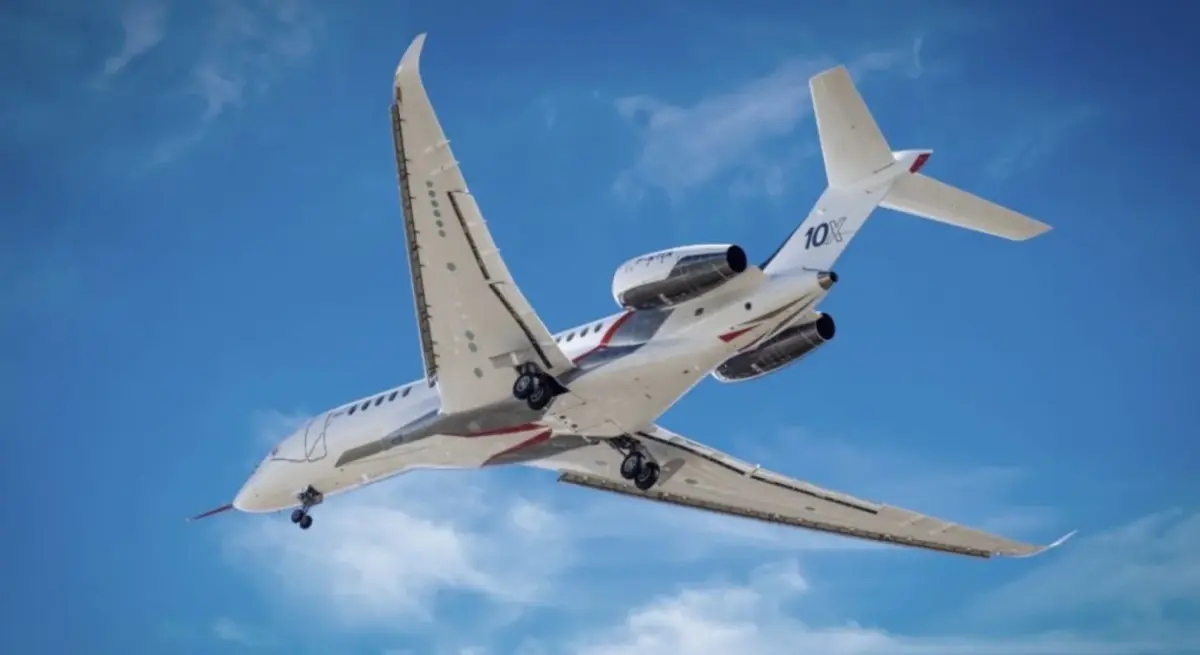
Two Pearl 10X-powered Falcon 10X prototypes in flight. Photo: Dassault Aviation.
LAS VEGAS, United States — Rolls-Royce has begun serial production of the Pearl 10X engine for Dassault Aviation’s Falcon 10X, moving the ultra-long-range business jet closer to its planned entry into service in late 2027.
Production is under way at Rolls-Royce’s business aviation engine facility in Dahlewitz, Germany, according to reporting published as the industry gathered for NBAA-BACE in Las Vegas. The manufacturer has completed the engine testing required for certification and is finalising its submission to the European Union Aviation Safety Agency.
The milestone does not mean the Falcon 10X is available to charter. The aircraft remains in flight testing, while both the engine and aircraft must complete certification before customer deliveries can begin. Availability in the private jet charter market will follow progressively as delivered aircraft enter managed or commercially operated fleets.
For future charter passengers, however, the programme is significant. The Falcon 10X is being developed to combine a 7,500-nautical-mile range, a large multi-zone cabin and high-speed performance in an aircraft intended for nonstop intercontinental travel.
What Engine Production Means for Passengers
Starting serial production indicates that Rolls-Royce is moving beyond development engines and preparing powerplants for customer aircraft. This reduces one important manufacturing dependency, although the Falcon 10X programme still depends on certification, production ramp-up and the delivery schedule.
Rolls-Royce has already supplied engines for Dassault’s flight-test aircraft and associated spares. Aviation Week reported that production has started at Dahlewitz while integrated engine and aircraft testing continues.
The Pearl 10X produces more than 18,000 pounds of thrust, making it the most powerful engine Rolls-Royce has developed specifically for business aviation. It is the first Rolls-Royce engine selected to power a Dassault business jet.
The engine completed an extensive development programme on the ground and aboard Rolls-Royce’s Boeing 747 flying testbed. By the Falcon 10X’s first flight in June 2026, the programme had accumulated more than 4,000 hours of testing, including over 25 flights and approximately 36,000 nautical miles aboard the testbed. Rolls-Royce confirmed that the aircraft’s first flight began the next phase of combined airframe and engine evaluation.
For charter clients, engine production matters indirectly. A reliable production and support programme can influence aircraft availability, maintenance planning and dispatch performance once the type enters commercial service. Those factors ultimately affect whether an aircraft can operate a confirmed itinerary as planned.
A 7,500-Nautical-Mile Aircraft for Long-Range Charter
Dassault publishes a maximum range of 7,500 nautical miles at Mach 0.85, based on eight passengers, four crew members and NBAA instrument-flight reserves.
That range is intended to support city pairs including New York–Shanghai, Los Angeles–Sydney, Hong Kong–New York and Paris–Santiago without a scheduled fuel stop. Other potentially relevant missions include Singapore to major European or North American destinations, depending on winds, payload and operational requirements.
Published range should not be interpreted as a guarantee for every flight. Actual nonstop capability depends on passenger and baggage load, weather, airspace restrictions, airport elevation, runway conditions and required fuel reserves.
This distinction is particularly important on ultra-long-range charter missions. A route that appears to fall within an aircraft’s maximum range may still require a technical stop when strong headwinds, conflict-related diversions or conservative reserve requirements are applied.
The Falcon 10X will have a maximum operating speed of Mach 0.925. High-speed capability can reduce journey time when operational conditions permit, although charter flights generally balance speed against fuel consumption, range and cost rather than operating continuously at the aircraft’s maximum limit.
Cabin Space Designed for Journeys Exceeding 15 Hours
The clearest passenger-facing difference is likely to be the cabin.
At 9 feet 1 inch wide and 6 feet 8 inches high, the Falcon 10X is designed with the largest cross-section among purpose-built business jets. Its cabin is expected to measure almost 54 feet in length, excluding the cockpit and baggage compartment, with a total volume of approximately 2,780 cubic feet.
Those dimensions allow customers to specify three- or four-zone layouts. Depending on the individual aircraft, configurations may include separate dining and meeting areas, private sleeping accommodation and an optional shower.
For charter passengers, the exact layout will matter as much as the aircraft model. Two Falcon 10Xs may offer different seating capacities, bed arrangements, galley facilities and baggage allowances. A broker should therefore confirm the configuration of the specific aircraft offered rather than relying on the manufacturer’s demonstration interior.
Dassault says the cabin will maintain an altitude of approximately 3,000 feet while the aircraft is cruising at 41,000 feet. The design also includes continuously renewed fresh air, separate temperature zones and 38 large windows. These features are intended to reduce some of the fatigue associated with spending 12 to 15 hours aboard an aircraft, although individual passenger experience will vary.
Full-flight access to the baggage compartment is another relevant feature for long journeys. It allows passengers or crew to retrieve luggage without waiting for a technical stop or arrival.
Airport Access Could Broaden Itinerary Options
Dassault is targeting a takeoff distance of less than 6,000 feet at maximum takeoff weight under specified standard conditions and a landing distance of less than 2,500 feet under its published reference assumptions.
This could give the Falcon 10X access to some airports that are less practical for comparable large-cabin jets. For clients, a suitable regional or secondary airport can shorten the ground journey and reduce reliance on congested commercial gateways.
Airport access will nevertheless remain mission-specific. Runway length alone does not determine suitability. Surface strength, elevation, temperature, obstacles, fire category, parking, customs, fuel and handling services must also be considered.
An airport may accommodate a lightly loaded Falcon 10X on arrival but be unsuitable for a fully fuelled intercontinental departure. Jetbay would assess the actual route and operating conditions before presenting an airport as viable.
Sustainable Aviation Fuel Capability
Rolls-Royce states that the Pearl 10X has been tested for operation with 100 per cent sustainable aviation fuel. The engine uses the company’s Advance2 core and an enlarged fan intended to improve efficiency compared with earlier designs.
This capability does not mean every Falcon 10X charter will operate on pure SAF. Availability remains limited and varies substantially between airports, while the fuel supplied must meet applicable technical and regulatory standards.
Clients interested in lower-carbon charter options should ask whether physical SAF is available at the departure airport or whether a recognised book-and-claim programme can be used. Any environmental claim should identify the method employed rather than implying that SAF is automatically included.
The Pearl 10X should also be distinguished from the engines fitted to other ultra-long-range aircraft. The Pearl 15 powers the Bombardier Global 5500 and 6500, while the Pearl 700 powers Gulfstream’s G700 and G800. Bombardier’s Global 7500 and Global 8000 use GE Aerospace Passport engines.
When Will Clients Be Able to Charter a Falcon 10X?
Dassault has publicly indicated that initial customer deliveries are expected toward the end of 2027. That remains a programme target rather than a guaranteed date.
Private charter availability will probably develop later and gradually. Initial aircraft may be retained exclusively for their owners, while others could enter managed fleets with limited third-party charter access. Operator certification, crew training and aircraft positioning will also influence where the type becomes available.
Early Falcon 10X charter supply is therefore likely to be limited and concentrated around major business aviation markets. Pricing has not been established and will depend on operating costs, fleet availability, route length and owner restrictions.
Rolls-Royce’s move into serial engine production is an important industrial milestone, but charter clients should view it as evidence of programme progress rather than immediate booking availability. The meaningful passenger milestone will come when certified aircraft begin entering commercially operated fleets.
Jetbay can compare currently available ultra-long-range aircraft for immediate travel while monitoring the Falcon 10X’s progress toward certification, delivery and eventual private jet charter service.